He took power before he had finished growing
Nguyễn Phúc Chu was born in 1675, the eldest son of Lord Nguyễn Phúc Thái. His father died in 1691 and the court raised him to the seat. A study of Thạch Liêm's voyage records that he was seventeen when he took power. The year of his birth and the year he succeeded are not in dispute.
Two years later, in 1693, his officials raised him to Grand Preceptor and Duke of the Realm and offered him the style Quốc chúa, lord of the country. He used those two words in his edicts and his correspondence from then on.
He held power for thirty-four years. In that time he had a bell cast, a stele raised and three characters written for a board, and all three are still there, which is not true of much from the age of the lords.
The man he wanted was a sea away
In the eighth month of 1694 an envoy from Đại Việt arrived at the Trường Thọ hermitage in Guangdong. The man he had come for was Thạch Liêm, known as Đại Sán, the abbot there, famous across Lĩnh Nam both for his teaching and for his verse.
It was not the first invitation. The previous lord, Nguyễn Phúc Thái, had already sent men to fetch him, and this time the party carried a letter from the lord himself along with a private letter from the state preceptor Hưng Liên. Three invitations in a few years, for one man on the far side of a sea.
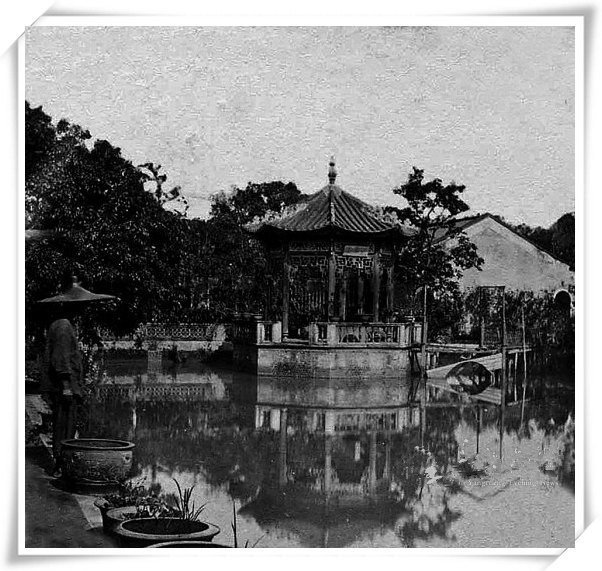
On the fifteenth night of the first month of 1695 Đại Sán boarded a ship at Hoằng Phố with more than 20 monks. On the 27th the ship reached Cù Lao Chàm off the mouth at Hội An, where the party transferred to a warship the lord had sent to meet it, and went straight on to Thuận Hóa.
A thousand workmen in three days and nights
Four days after his guest arrived, the lord sent officers of the inner household and the Board of Works with more than 1,000 people, soldiers and craftsmen alike, who in 3 days and nights put up 5 bays of abbot's quarters and 5 bays of lodging for Đại Sán and his party.
At their first audience the lord spoke first. He said he had long admired the old monk's way, that he was fortunate the distance had not put him off coming, and that he asked to be taught so that he would know the right road to walk.
Đại Sán answered that the way of a ruler lay in governing the country and settling the people, and that a ruler who let go of orders and discipline in order to force his way to stillness had not understood stillness at all.
Between the two men stood a wall neither could take down. Đại Sán wrote that their speech did not reach each other, that even with an interpreter the sense was not sure, and that of ten things said the translation carried three or four. After that, when he wanted something understood in full, he wrote it out on paper.
Fourteen hundred people in monks' robes
One evening the lord brought Đại Sán into the palace and the two of them talked until midnight. Over the table the lord said that most of the monks in his country kept no discipline, so he would send orders to every prefecture to bring them in, and that only those who took all three platforms of the precepts would get a certificate and exemption from tax.
The assembly opened on the first day of the fourth month. On the sixth Đại Sán conferred the full monastic precepts. On the eighth, the Buddha's birthday, the lord took the bodhisattva precepts together with his mother, his sister, the inner palace and his household.
On the twelfth more than 1,400 people, newly ordained, put on robes, took up begging bowls and walked a round of alms in the old manner, then gave thanks to the lord. He invited both ranks of clergy to a vegetarian meal and added a gift of 300 quan in cash and 100 measures of rice.
From that assembly the lord carried a dharma name, Hưng Long, a religious style, Thiên Túng đạo nhân, and a claim to stand in the thirtieth generation of the Tào Động line.
The board hung in front of the palace
Because the interpreters carried so little across, Đại Sán wrote 4 articles out on paper and sent them up. The second dealt with garrisoning the frontier. The third proposed rotating soldiers home to their fields. The fourth asked for a school to be founded for the sons of officials and of ordinary men.
The weight in those articles came from what Đại Sán had seen. He wrote that in that country every trade was worked by soldiers, and that each year around the third and fourth months soldiers went out to the villages and took any man of 16 or over who was strong enough, holding him by a bamboo cangue about the neck.
On the twenty-fifth of the fourth month the lord asked him to set down everything the two of them had discussed. Đại Sán drew up a paper of 18 articles on establishing the state, covering the treatment of soldiers, the care of the people, trade, discipline and law.
The lord read it. He told the officer of the inner household to have the 18 articles cut into a board and hung in front of the palace, where soldiers, officials and commoners could all see them. He ordered 24 tallies made besides. Anyone wronged could carry a tally and lay a complaint, and the law was to be applied whether the offender was a commoner or a relative of the lord.
A ruler of twenty had the counsel of a guest of six months cut into a board and hung at his own gate.
Seven years later, two Guangdong men took ship
The first of the four articles was the one the lord did not act on. Đại Sán urged him to open relations with the officials of the two Guang provinces and then send a memorial to the Qing court asking for a title, so that he would have their weight behind him.
The lord answered that he lived in a far corner by the sea and knew little of such ceremony, and that a small country which had never once sent anything north could hardly send a memorial out of nowhere. The border officials would not pass it on, he said, and the journey would be wasted. He asked Đại Sán to speak for him first, once he was home.
In the fifth month of 1702 the lord sent Hoàng Thần and Hưng Triệt to Guangdong with a state letter and goods. Both men were Guangdong men who had come over with Thạch Liêm and been received, which is why he chose them. The goods were listed to the ounce: eaglewood 5 cân and 4 ounces, raw gold 1 cân 13 ounces 5 đồng, two elephant tusks weighing 350 cân, and 50 lengths of rattan.
The answer came back that the country of Quảng Nam stood strong in its quarter, that Champa and Chân Lạp had both gone into it, and that it would grow larger still. But the country of An Nam still had the Lê house in it, and so no separate title could be granted. The matter was dropped.
He never got the title he asked for. The style he used all his life was the one his own officials had given him in 1693, at home.
Three seals under one preface
Before leaving Quảng Nam, Đại Sán showed the lord the draft of his record of the journey and asked him for a preface. The lord wrote one and dated it to the fifth lunar month of the year Bính Tý, which is 1696.
At the foot of it he signed himself king of Đại Việt, Nguyễn Phúc Châu, a disciple who had taken the bodhisattva precepts, dharma name Hưng Long. Under that he stamped 3 seals: thirtieth generation of the orthodox Tào Động line, the seal of Nguyễn Phúc Châu, and Thiên Túng đạo nhân.
That preface stands at the head of the Overseas Record, a book cut and printed in China. The original edition held in the Tōyō Bunko in Japan carries his text in full. The copy in the National Central Library has no writing by Nguyễn Phúc Châu in it at all.
His hand survives in one thinner place as well. Several of his poems on the scenery of Thuận and Quảng were painted onto porcelain ordered from China, signed only with two characters meaning written by the man of the way. One of them listens to the surf at Tam Thai in the Marble Mountains, where he had gone walking with Đại Sán. Another takes the spring cloud over the Ải Lĩnh pass, and it was that poem whose first four lines a nineteenth-century imperial gazetteer later printed, naming the author as Hiển Tông, which is to say this lord.
The two things he left at Thiên Mụ
In 1710, on the Buddha's birthday, the lord had a great bell cast for the Thiên Mụ pagoda. It weighs 1,986 kg, stands 2.5 m high and measures 1.4 m across the mouth. The ornament on its body carries emblems of all three of the great East Asian schools, Buddhist, Confucian and Daoist, and those who write about it read in them a wish for steady rain and wind, a country at peace and a people settled.
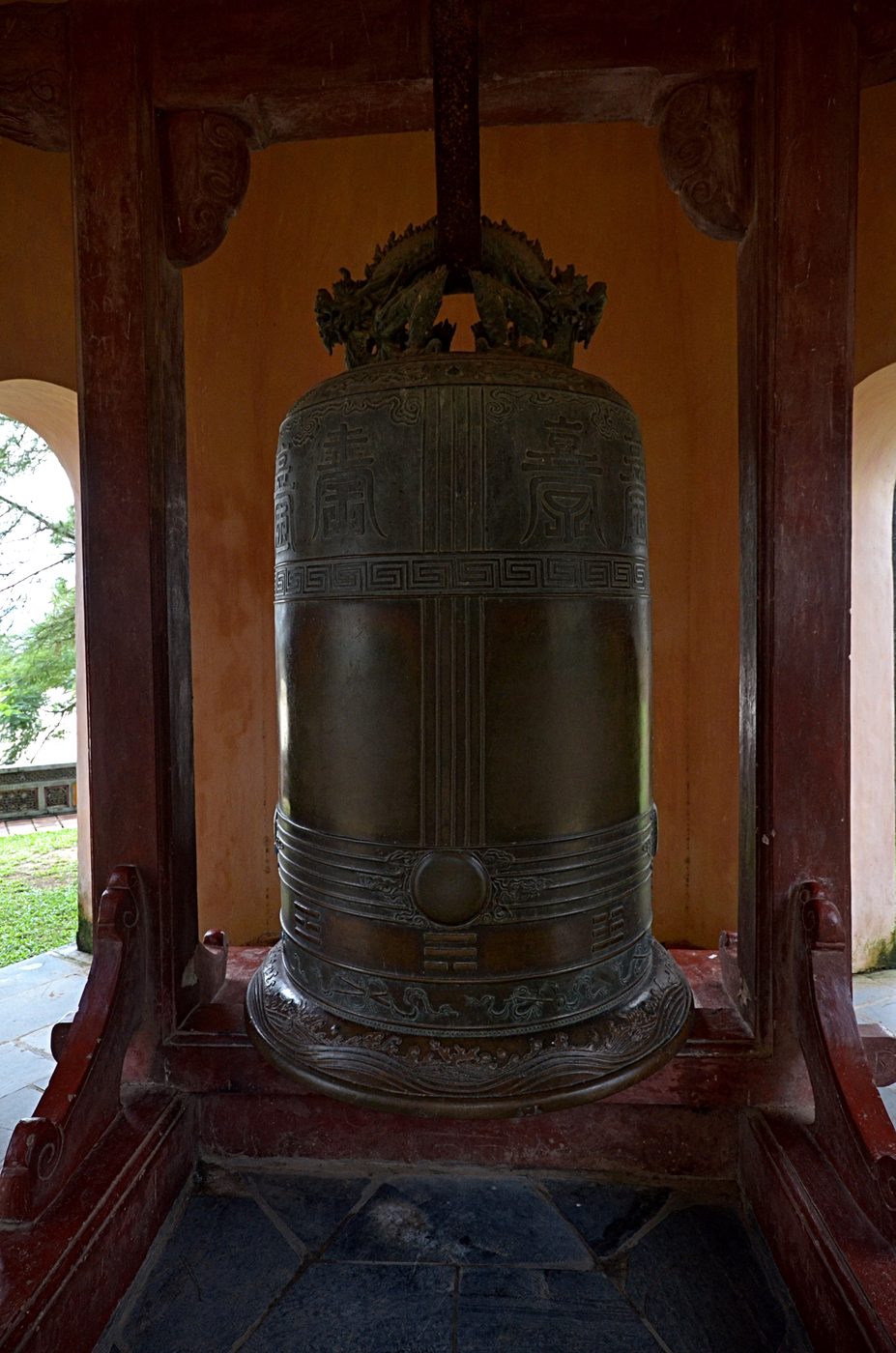 Photograph 2013 · Luk · CC BY-SA 4.0
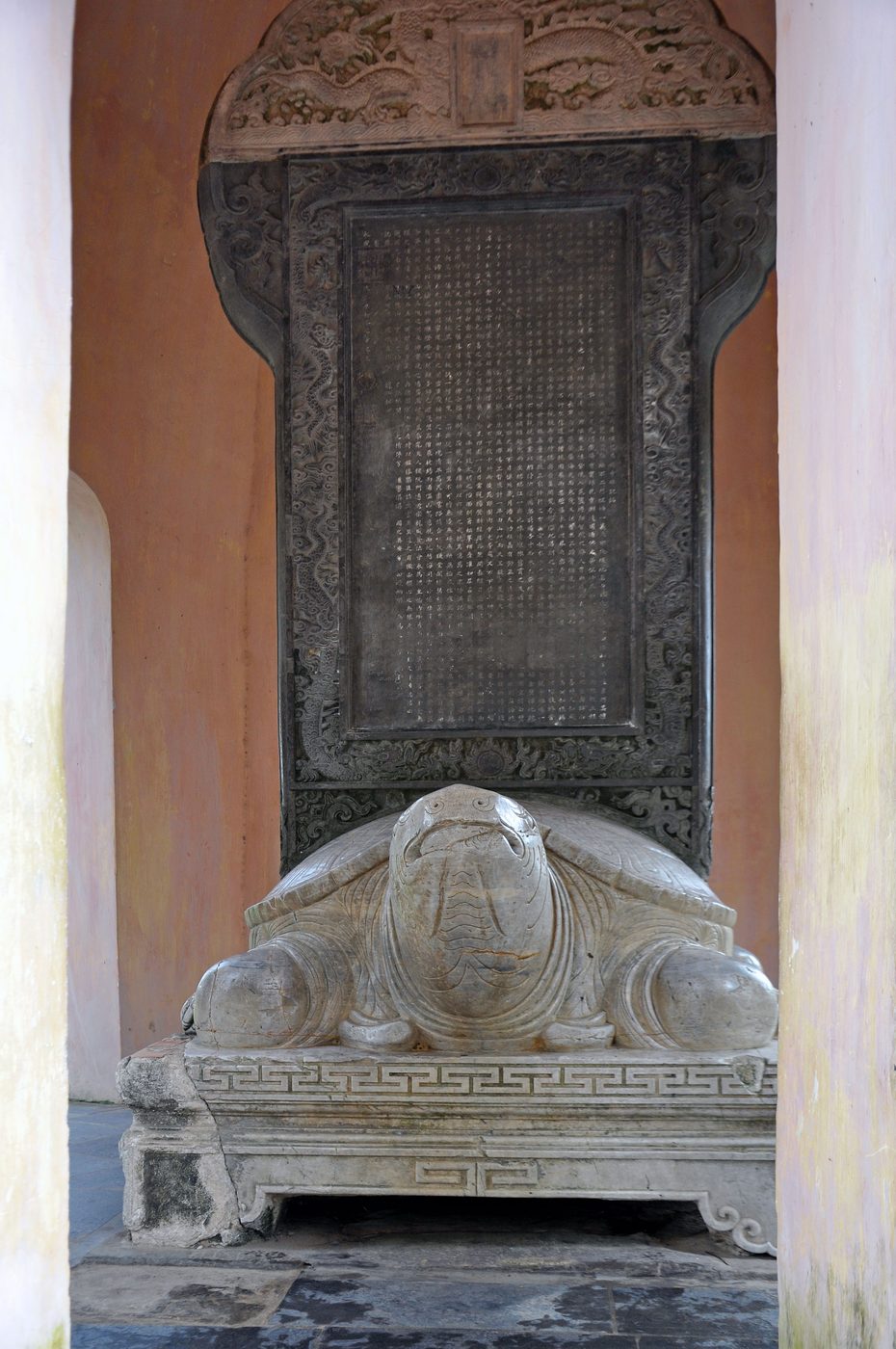
In 1714 he had the pagoda thoroughly rebuilt. The year after, standing in its grounds and looking out at the Perfume River and Kim Phụng mountain, he wrote a text of 1,250 Chinese characters titled the Thiên Mụ pagoda built by royal command, and had it cut into a grey marble stele 2.5 m high, dragons across its head, dragons chasing a flaming pearl along its border, the whole set on the back of a stone tortoise. Later writers take that stele as the beginning of the stele carving of Huế.
 Photograph 2015 · P. Hughes · CC BY 4.0
The monks no longer sound that bell. In December 2013 it was named a national treasure, and the stele is on the same list.
The song people in Huế still sing names exactly what he left: the bell of Thiên Mụ, and the cockcrow at Thọ Cương.
The bridge that was given a name
In the spring of 1719 the lord went to inspect the Quảng Nam command. The chronicle records that he reviewed the troops first, and only then went down to the town of Hội An.
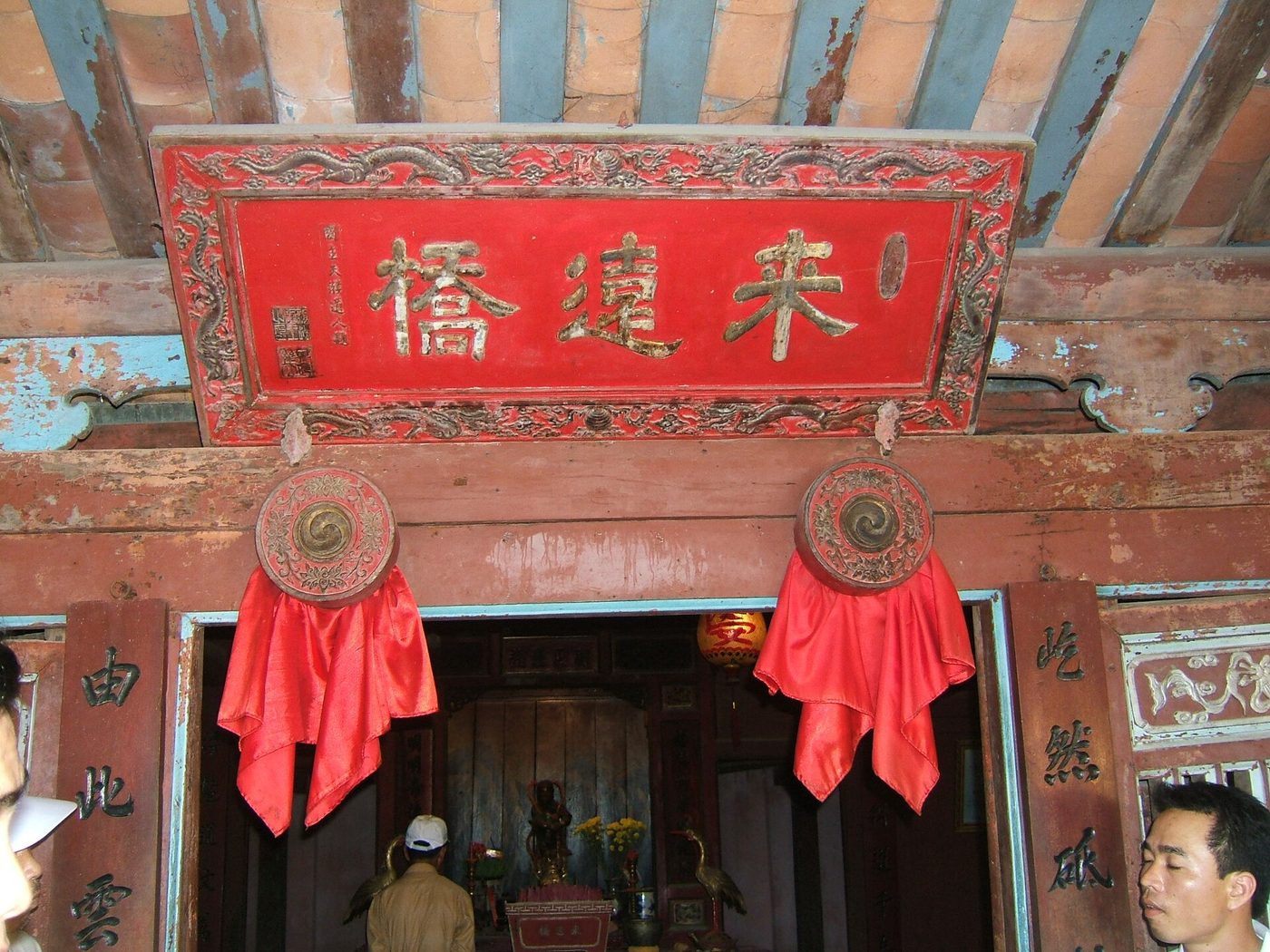
West of the town stood a roofed bridge where the trading ships gathered. The lord named it Lai Viễn, the bridge of those who come from afar, wrote the characters out and gave them to be set on a gilt board. The board still hangs over the crossing.
 Photograph 2007 · Viethavvh · public domain
Reading the gift as a message to foreign merchants is an inference, but the chronicle puts the naming and the gathered ships in the same sentence.
He died in 1725, after thirty-four years in power. The Nguyễn dynasty later gave him the temple name Hiển Tông.
- Hải ngoại kỷ sự — khảo cứu kèm trích nguyên văn bản dịch Viện Đại học Huế 1963
- Thiền sư Thích Đại Sán và tác phẩm Hải ngoại kỷ sự
- 《海外紀事》— Hải ngoại kỷ sự, quyển 1 (và các quyển liền kề), bản 識典古籍 CADAL02087136
- “Đại Việt dưới thời Lê Hy Tông (1676–1704)” — biên niên dịch và chú, chép nguyên văn Đại Nam thực lục về chuyến cầu phong năm 1702 và lời phúc đáp của nhà Thanh
- “Quốc chúa Nguyễn Phúc Chu và những bài thơ vịnh cảnh sắc vùng Thuận – Quảng trên đồ sứ ký kiểu”
- “Chúa Nguyễn Phúc Chu và hai bảo vật quốc gia chùa Thiên Mụ” — Tạp chí Nghiên cứu Phật học
- “Chúa Nguyễn Phúc Chu với việc đặt tên cầu Lai Viễn ở Hội An” — chép nguyên văn Đại Nam thực lục tiền biên quyển 8 tờ 28 về chuyến kinh lý năm 1719
- “Chúa Nguyễn Phúc Chu (1675–1725) Minh Vương” — Tu viện Quảng Đức
- “Nguyễn Phúc Chu” — Wikipedia tiếng Việt
- 「大汕」 — Wikipedia tiếng Trung; Thạch Liêm 1633–1704, Tào Động đời 29, chuyến đi sứ năm 1702
- 「海外纪事」 — Wikipedia tiếng Trung; sáu quyển, soạn 1696, in 1699
- Ảnh bia “Ngự Kiến Thiên Mụ Tự” và Đại hồng chung chùa Thiên Mụ trên Wikimedia Commons
- “Một số thông tin về Hội An, Quảng Nam qua ghi chép của Quốc sử quán triều Nguyễn trong Đại Nam thực lục”
- Mục lục tổng BAVH — bảng tra bài theo đề tài, gồm mọi bài về Faifo, quan Cai Bộ và thủ tục hải quan, phái bộ Công ty Đông Ấn Anh 1695–1696, mộ người Hà Lan ở Faifo
- Hội An - trung tâm giao thương khu vực và quốc tế

- 长寿寺:佛门做了大戏台 — không rõ, chuyên mục lịch sử Quảng Châu trên Sohu, Bản quyền tác giả