People call him by more than ten names
Bắc Đế Trấn Vũ is also called Bắc Phương Chân Võ Huyền Thiên Thượng Đế, Huyền Thiên Thượng Đế, Chân Võ Đại Đế, Bắc Cực Đại Đế, Huyền Vũ Thánh Quân, Khai Thiên Đại Đế, and in ordinary speech Thượng Đế Công or Đế Gia Công. That many names for one figure.
He is one of the great gods of Daoism. His charge is the north, and with it the water tribes, which makes him a water god as well.
The old scheme divided the sky into five quarters, each with its own lord and its own colour: the blue lord in the east, the red in the south, the white in the west, the yellow at the centre, and the north, whose colour is black, under a lord called the dark emperor or the black emperor.
In the five phases the north answers to Water. He holds the north, so he holds the water.
Forty-two years on Mount Wudang
The Daoist scriptures make him the 82nd manifestation of Lao Tzu deified, born to the king of the country of Tĩnh Lạc and his queen Thiện Thắng. The queen dreamed she swallowed the moon and conceived, and the pregnancy ran 14 months, more than four hundred days, before he was born.
Grown, he left his family for Mount Wudang and took up the way. After 42 years he completed it, and the Jade Emperor gave him a title and the charge of the north.
The Song emperors added to his rank more than once. In 981 he was made General of Assisting Flourishing, and in 1014 he was raised again.
The name Trấn Vũ, the one people at Hội An use, is a name of avoidance. He was Huyền Vũ, but the character Huyền fell inside the personal name of a Song ancestor, so it had to change.
He arrived after the Japanese left
In 1635 the shogunate closed the sea to Japanese ships and barred those already abroad from coming home, except for anyone gone less than five years. The Japanese quarter at Hội An lost its supply of people from that point.
The Chinese went the other way. Their numbers and their trade both grew, they moved across into the Japanese quarter, and they took the market with them.
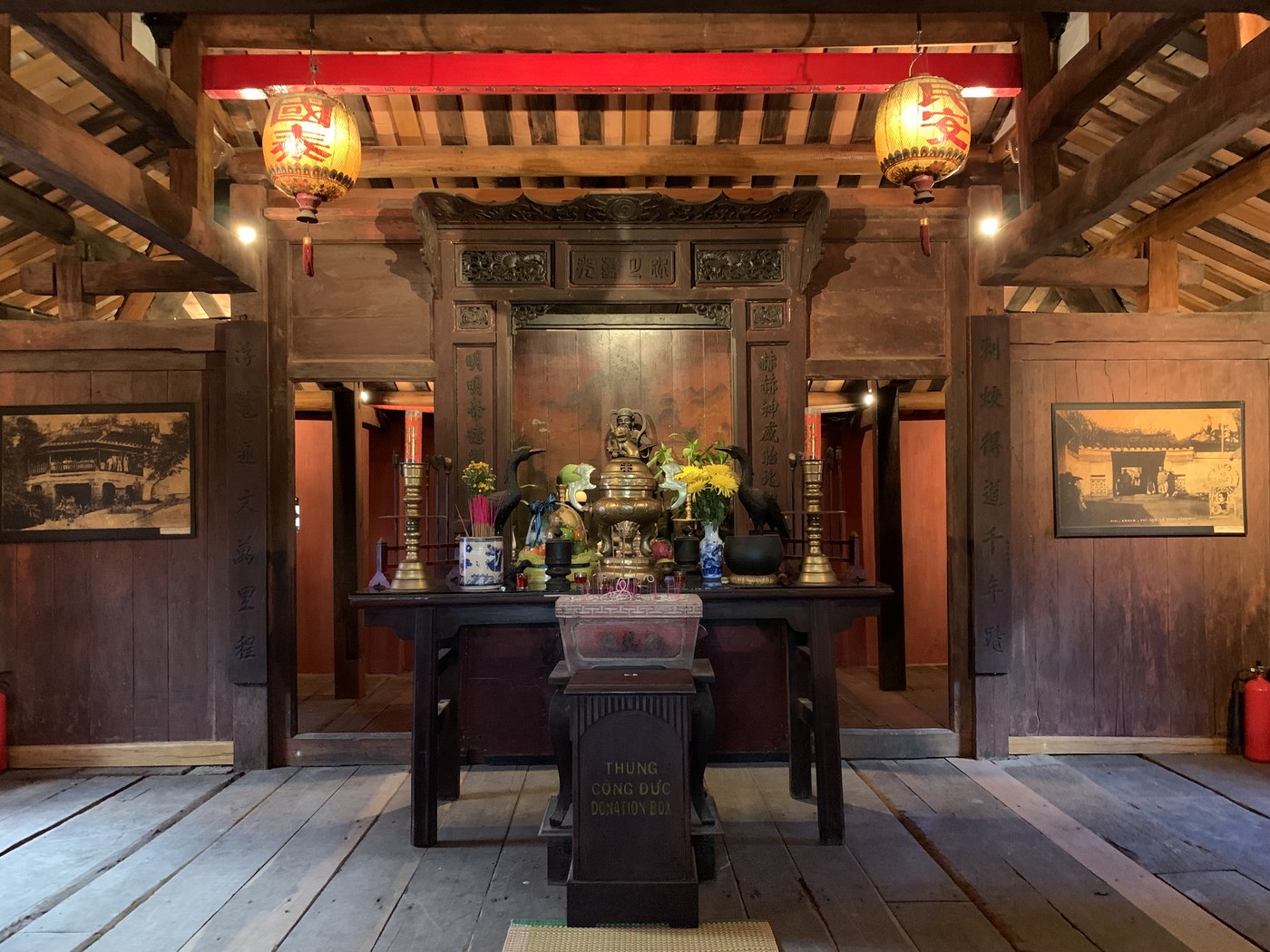
In 1653 they put up a small shrine beside the bridge and installed Bắc Đế Trấn Vũ in it. Vietnamese speakers called the shrine a pagoda, and the bridge has been the Pagoda Bridge ever since.
The god of the north travelled a long way. From Mount Wudang to a small shrine built over a creek in a southern port.
He took over the work of a catfish
Something was already at that spot before him. The Japanese called it Namazu, a giant catfish lying in the mud, and when it thrashed the ground shook. Vietnamese speakers called it con Cù, and the Chinese called it Câu Long.
The Japanese at Hội An told it this way: the creature's head lay back home in Japan, its tail reached as far as India, and its back crossed exactly the channel here. When it turned, Japan had an earthquake and Hội An had no peace. The bridge went up over its spine like a sword driven down.
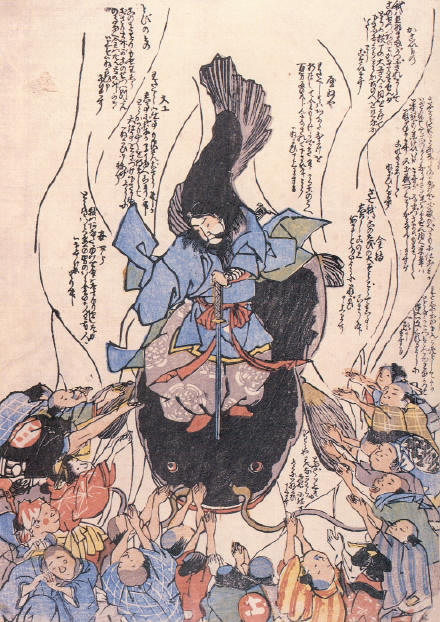 Edo-period woodblock print, 1855 · artist unknown · public domain
In Japan holding the catfish down was the work of the god Kashima. When Kashima tired or looked away, it thrashed. After the Edo earthquake of 1855, which killed nearly 7,000 people, woodblock prints of the fish sold all over the city under the name namazu-e. One study of the belief counted 130 Namazu shrines in Japan before 1970.
At Hội An the job passed to Bắc Đế. The physician A. Sallet set down what the town said: the shrine and the statue were put there to stop the creature that had its lair below, and to make sure of it a gold sword was buried before the work began and four stones cut with charms were set at the four corners of the foundation.
Two beliefs, two peoples, one task: keep the water down.
A table 1.2 metres high, painted peaks behind
The statue stands at the centre of the shrine on a wooden table about 1.2 m high. In front of it are a bronze censer and candlesticks and a blue and white porcelain vase.
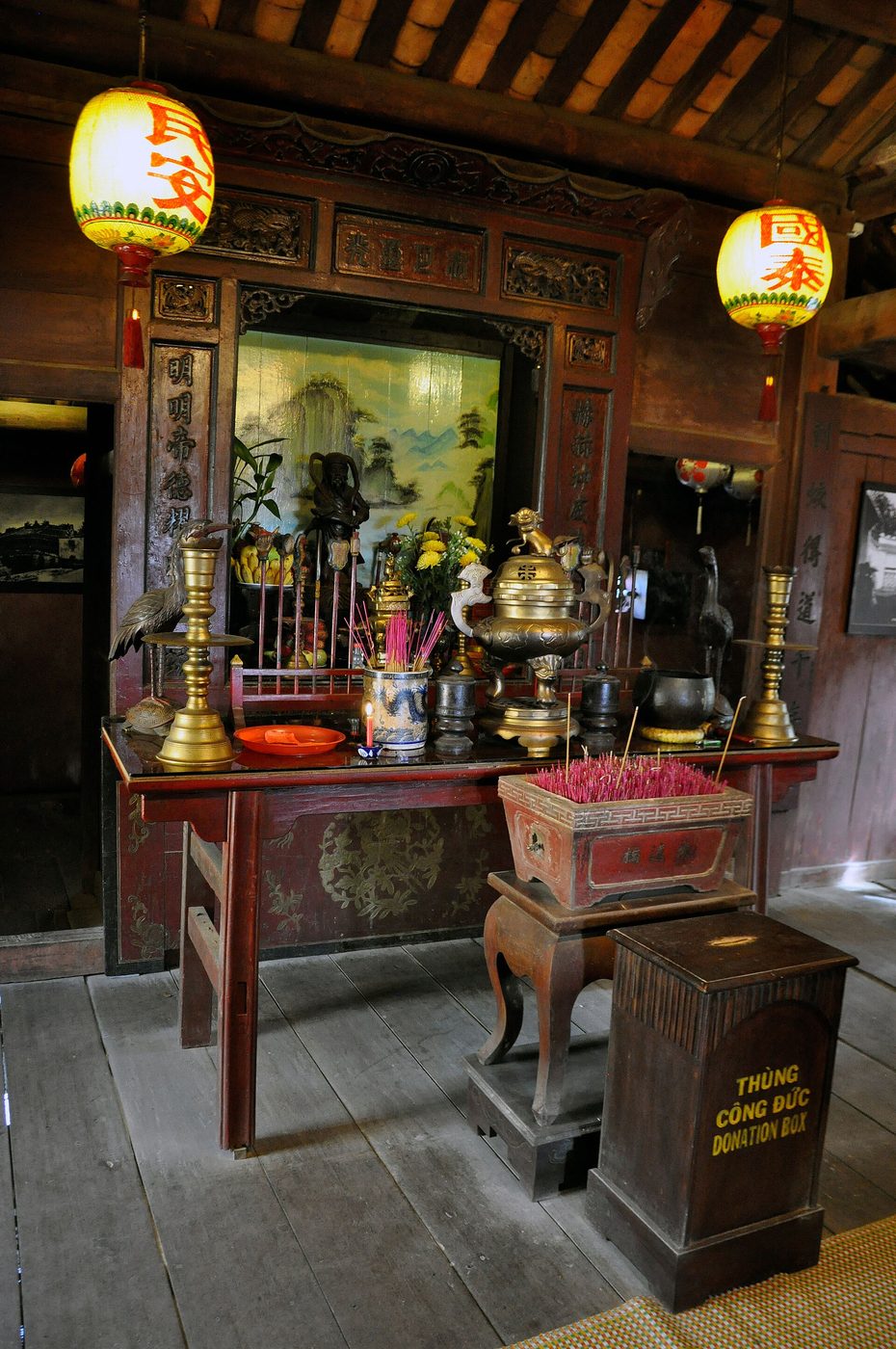 Photograph 2015 · P. Hughes · CC BY 4.0
Behind him a wooden panel is painted with sheer mountain peaks. The carver gave him a red face, a snake in his hand and a tortoise beneath his feet, in the posture of a god about to act.
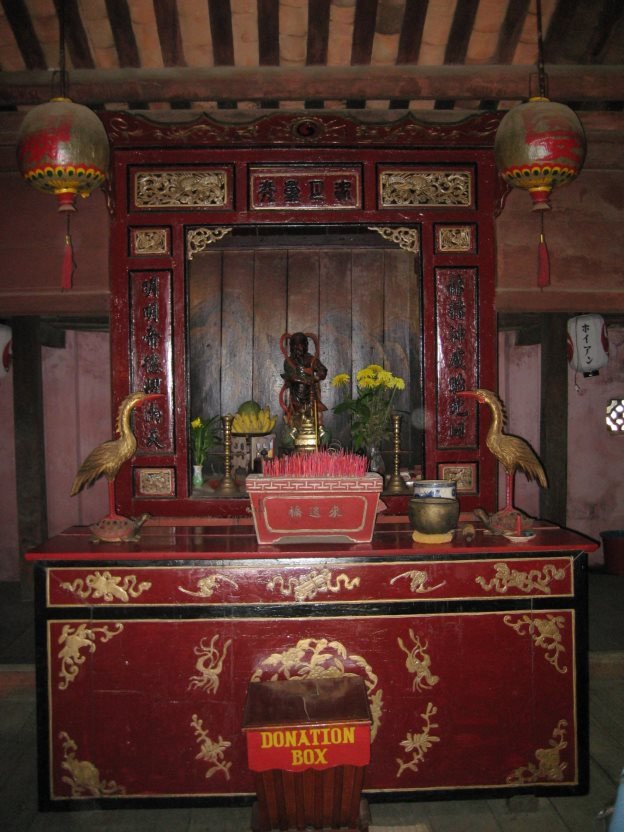
A couplet in Chinese characters flanks the niche. It says that his power shows itself at the northern gate and his virtue is plain under the southern sky.
A god of the north, kept under the southern sky, on a bridge.
A red wooden tally, twelve centimetres
In the Museum of Folk Culture at Hội An, in the room given to folk forms and performance, there is a carved wooden piece called the tally of Bắc Đế. It is about 12 cm long, 8 cm wide and 3.5 cm thick, coated in red lacquer, square at the base and arched at the top.
The front is cut with four characters reading command of the five thunders. The back carries a tortoise in relief with a snake on its back, coiled around a sword, which is the emblem of Bắc Đế exactly.
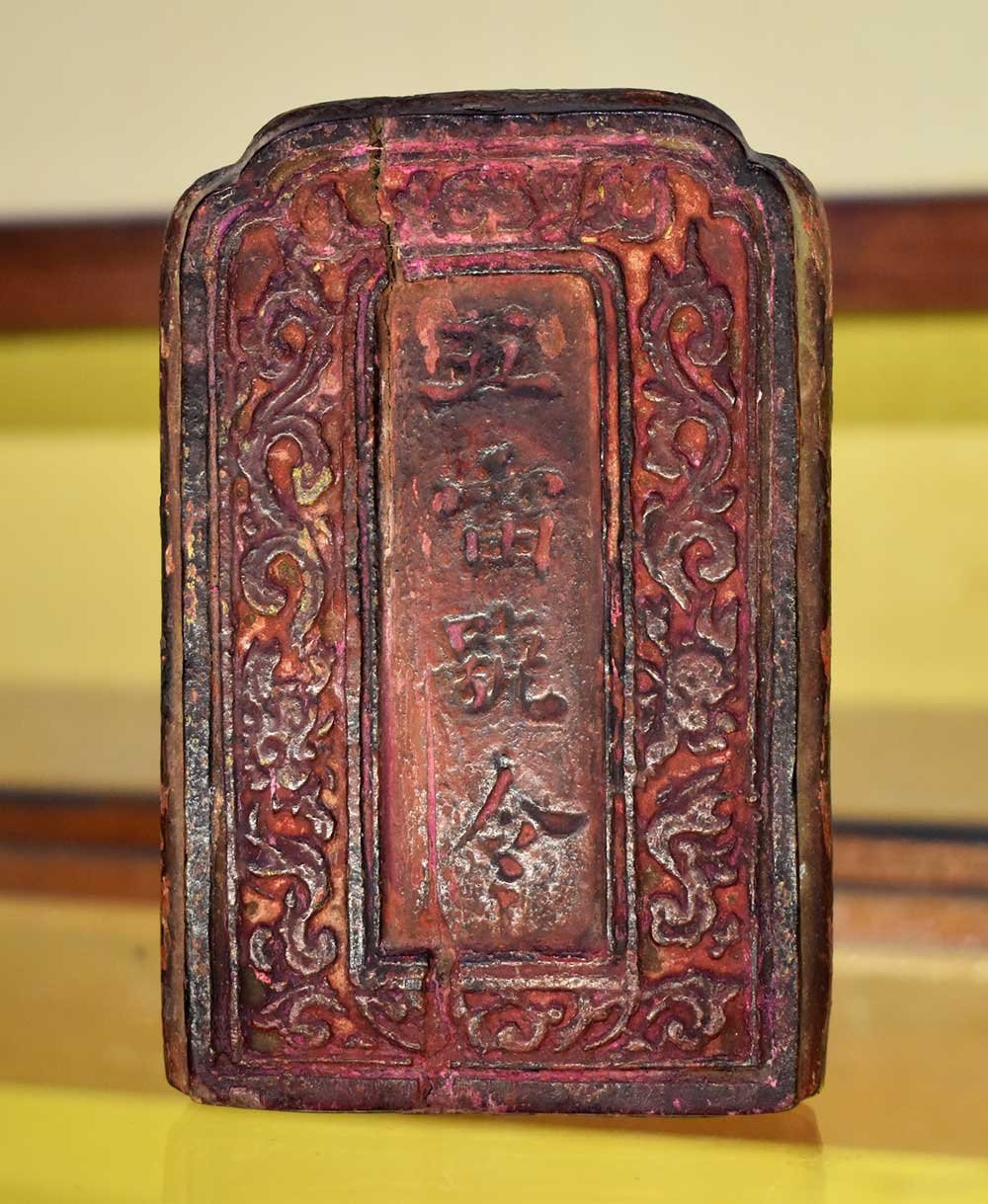
A five thunders tally is a Daoist priest's implement, modelled on the tiger tally that Chinese emperors used to move their troops. Round above and square below, one face cut in, the other raised, after the manner of yin and yang.
Lê Huyễn handed this one to the Hội An heritage centre in 1997. There is still no ground for saying whether it was ever a charm set into a building or the working implement of a priest.
Few now remember what the piece originally meant. What remains is the idea of a charm that brings safety, and on the first and the fifteenth of the month people from the town still bring incense to stand in front of him.
- Thông tin nghiên cứu bảo tồn di sản — Chuyên đề: Di tích Chùa Cầu / Journal of Research in Heritage Preservation, Vol 03(55)-2021, Theme: The Japanese Covered Bridge (song ngữ Việt–Anh, 182 trang, 24 bài)
- Về hiện vật Lệnh phù Bắc Đế trưng bày tại Bảo tàng Văn hóa Dân gian Hội An
- Một vài hình thức trấn yểm ở Hội An
- Giải bí ẩn cây cầu trấn yểm thủy quái Hội An
- Cây Đa, bia Yểm thủy đạo
- Bề dày lịch sử văn hóa của Chùa Cầu nhìn từ một truyền thuyết
- Vài thông tin về nghệ thuật trang trí tại di tích Chùa Cầu
- BAVH 1919 số 4 — chứa chuyên khảo “Le Vieux Faifo”: I. Souvenirs chams · II. Souvenirs japonais (tr. 506–516) · III. Les tombes européennes (tr. 501–519). Khảo tả Faifo cổ của một người Pháp sống tại chỗ
- Tranh khắc gỗ namazu-e thời Edo, năm 1855 — thần Kashima ghìm con Namazu bằng thanh kiếm; qua Wikimedia Commons
- Chùa Cầu Hội An — Một di tích độc đáo về kiến trúc nghệ thuật

- Sự cộng cư — nhìn từ Chùa Cầu — Hoài An, báo Đà Nẵng, Bản quyền tác giả
- Về hiện vật Lệnh phù Bắc Đế trưng bày tại Bảo tàng Văn hóa Dân gian Hội An — Trung tâm Quản lý Bảo tồn Di sản Văn hóa Hội An, Bản quyền tác giả